Soft Skills Every Teen Needs for Their First Job (And How to Build Them)
Career Skills · 15 min read · Published 2025-11-05
TL;DR
Soft skills beat hard skills for first jobs—employers can teach registers in hours, but not reliability or communication. The 10 essentials: Communication, Teamwork, Time Management, Problem-Solving, Adaptability, Work Ethic, Customer Service, Attention to Detail, Positive Attitude, Professionalism. Build them through sports, clubs, volunteering, and family responsibilities. Prove them on resumes with numbers + verbs ("Balanced 15 hrs/week work with 3.8 GPA") and in interviews using STAR method. Youth unemployment is 10.8% (July 2025), but skills-first hiring opens doors for those who demonstrate capability.
When you're competing for your first job with zero work experience, soft skills are your secret weapon. You might not have five years in retail or food service, but you absolutely have skills employers value—you just need to recognize them, build them on purpose, and prove them with real examples.
The job market rewards teens who show strong people skills, reliability, and adaptability. In July 2025, the youth unemployment rate (ages 16–24) was 10.8%, up from 9.8% the previous summer—so candidates who communicate, collaborate, and self-manage rise to the top. Meanwhile, employers are leaning into skills-first hiring, reducing degree requirements for some roles and opening doors for talent that can demonstrate capability—especially reliability and soft skills.
This guide breaks down the 10 essential soft skills for teen employment, how to build each one through school, sports, and life, and how to showcase them on resumes and in interviews.
Why Soft Skills Beat Hard Skills (for Your First Job)
- Hard skills are job-specific (registers, latte art, Excel) and often taught in 1–2 weeks on the job.
- Soft skills (communication, teamwork, time management) are portable, predict long-term success, and signal maturity.
- Employers facing changing skill needs and talent shortages increasingly prioritize demonstrated ability over credentials.
What hiring managers tell us: "I can teach a register in an hour. I can't teach reliability, calm under pressure, or respectful communication in a month."
The 10 Essential Soft Skills (and How to Build + Prove Them)
1) Communication (Verbal + Written)
What it looks like: Clear speaking, active listening, asking clarifying questions, professional emails, adapting tone to audience (customer vs. manager).
Build it:
- Join the debate team, theater, or a speaking club to practice concise messaging.
- Email teachers using professional format (subject lines, greetings, sign-offs).
- Volunteer in customer-facing roles: library desk, community center.
Prove it (resume): "Delivered 15+ presentations to classes of 20–50 students; recognized for clarity and audience engagement."
Prove it (interview): Use STAR to share a time you explained something complex simply or fixed a miscommunication.
2) Teamwork & Collaboration
What it looks like: Sharing workload, respecting different styles, backing teammates under pressure, and resolving conflicts professionally.
Build it:
- Play team sports or join group clubs (band, robotics, yearbook).
- Do service projects with Habitat or local food banks.
- In group assignments, volunteer to coordinate or own logistics.
Prove it (resume): "Collaborated with 12 peers to plan a fundraiser generating $3,200; led sign-ups and shift coverage."
Prove it (interview): "Tell me about a time someone wasn't contributing"—describe how you addressed it respectfully and delivered the result.
3) Time Management & Organization
What it looks like: Prioritizing, meeting deadlines, balancing school/activities/work, using planners, and knowing when to say no.
Build it:
- Time-block your week in a calendar; set artificial deadlines 24 hours before due dates.
- Track a week of time to spot leaks; use the 2-minute rule for quick tasks.
- Choose structured activities (sports, music) to create a routine.
Prove it (resume): "Balanced 15 hrs/week part-time work with varsity swimming (15 hrs/week) and 3.8 GPA."
Prove it (interview): Walk through your weekly schedule and tools (calendar, reminders) that keep you on track.
4) Problem-Solving & Critical Thinking
What it looks like: Staying calm, finding root causes, proposing options, learning from mistakes.
Build it:
- Do strategy games (chess, escape rooms) and DIY fixes at home.
- When learning a task, ask why the steps exist (not just what).
- After a setback, perform a quick post-mortem: What happened? What will I change?
Prove it (resume): "Resolved rehearsal conflict for school play by proposing an adjusted schedule; plan adopted by cast and director."
Prove it (interview): Share a rush/problem story and narrate your thinking, not just the fix.
5) Adaptability & Flexibility
What it looks like: Rolling with schedule changes, learning new stations, staying positive when plans shift.
Build it:
- Say yes to new experiences (different clubs, roles, or age groups in camps).
- Learn a new skill from scratch (instrument, coding, new sport).
- Work with different teams; practice switching your approach to fit others.
Prove it (resume): "Shifted from in-person to remote learning while maintaining 3.7 GPA; mastered Zoom/Docs in one week."
Prove it (interview): Describe a last-minute change you handled—and the outcome.
6) Work Ethic & Reliability
What it looks like: Showing up early, following through, quality without reminders, finding coverage responsibly.
Build it:
- Stick with a team, club, or volunteer role for a full season or longer.
- Own household responsibilities without prompting.
- Track attendance; aim for 95%+ at school/activities.
Prove it (resume): "Maintained 98% attendance over two years while balancing job, varsity soccer, and 3.6 GPA."
Prove it (interview): Quantify reliability (shifts covered, seasons completed, absence rate).
7) Customer Service Mindset
What it looks like: Friendly, patient, solutions-oriented; you anticipate needs and represent the brand well.
Build it:
- Volunteer where you interact with the public (front desk, rec center).
- Practice active listening (repeat back: "So you're looking for…").
- Notice great service when you experience it; copy the specifics.
Prove it (resume): "Supported 50+ families per shift at YMCA desk; resolved billing questions and maintained 95% satisfaction."
Prove it (interview): Share a time you turned a frustrated person into a satisfied one (specific steps + result).
8) Attention to Detail & Quality
What it looks like: Following instructions, double-checking, catching small errors that matter.
Build it:
- Proofread messages to teachers; read instructions twice.
- Cook or bake (measurements = precision).
- Keep a clean, organized station; take detailed notes when trained.
Prove it (resume): "Maintained 100% cash-drawer accuracy over 6 months in a fast-paced retail environment."
Prove it (interview): Tell how you spotted a mistake early and prevented a bigger issue.
9) Positive Attitude & Enthusiasm
What it looks like: Energy, optimism, respectful tone—even on tough shifts.
Build it:
- Reframe: switch "this is hard" to "I'm getting better at this."
- Practice gratitude (three wins/day).
- Take breaks and sleep enough—burnout kills positivity.
Prove it (resume): "Voted Employee of the Month (2×) for teamwork and upbeat service during peak season."
Prove it (interview): Your demeanor is the proof. Smile, make eye contact, be curious.
10) Professionalism & Maturity
What it looks like: Appropriate dress, language, and boundaries; taking feedback; keeping personal drama personal.
Build it:
- Dress one step above minimum.
- When coached, say "Thanks—that helps," then apply it.
- Observe pros at work: how they speak, email, and handle conflict.
Prove it (resume): "Recognized for professional demeanor; mentored three new hires on day-one basics."
Prove it (interview): Arrive early, speak respectfully about past teachers/bosses, and keep examples work-focused.

Where Teens Actually Build Soft Skills (Without a Job Yet)
- Sports & Performing Arts: Pressure, teamwork, repetition, feedback loops.
- Clubs (DECA, Robotics, Yearbook): Deadlines, collaboration, presenting outcomes.
- Volunteering: Customer service, problem-solving with limited resources.
- Family Responsibilities: Reliability, time management, and communication with adults.
- Part-Time Work & Internships: The lab where all the above get stress-tested.
International research reinforces this: structured, moderate part-time work and career-connected learning help young people practice time management, follow instructions, and get along with others—skills employers reward.
Practice Drills: Turn Skills into Habits
Monthly Skill Focus
Pick one skill per month. Set three measurable actions.
Example (Communication):
- Ask one clarifying question in every class.
- Send two professional emails per week.
- Do a two-minute summary after each practice/game.
Reverse Role-Play
Have a parent/mentor act as an angry customer or a distracted manager; you practice the script to de-escalate, clarify, and solve.
Skills Audit
Rate yourself 1–10 on the ten skills. Any score <7 gets three actions this month.
Translate Experiences
For each activity on your resume, write a bullet that proves a soft skill with numbers + verbs.
Put Soft Skills on Your Resume (No Fluff)
Weak: "Excellent communication skills."
Strong: "Handled 30+ customer interactions per shift; explained return policy clearly and resolved issues without escalation."
Weak: "Team player."
Strong: "Worked with 5 peers to run concessions stand; balanced cash drawer and restocked between games, cutting wait times 20%."
Weak: "Hard worker."
Strong: "Completed close procedures and cleaning checklist 100% of shifts without reminders."
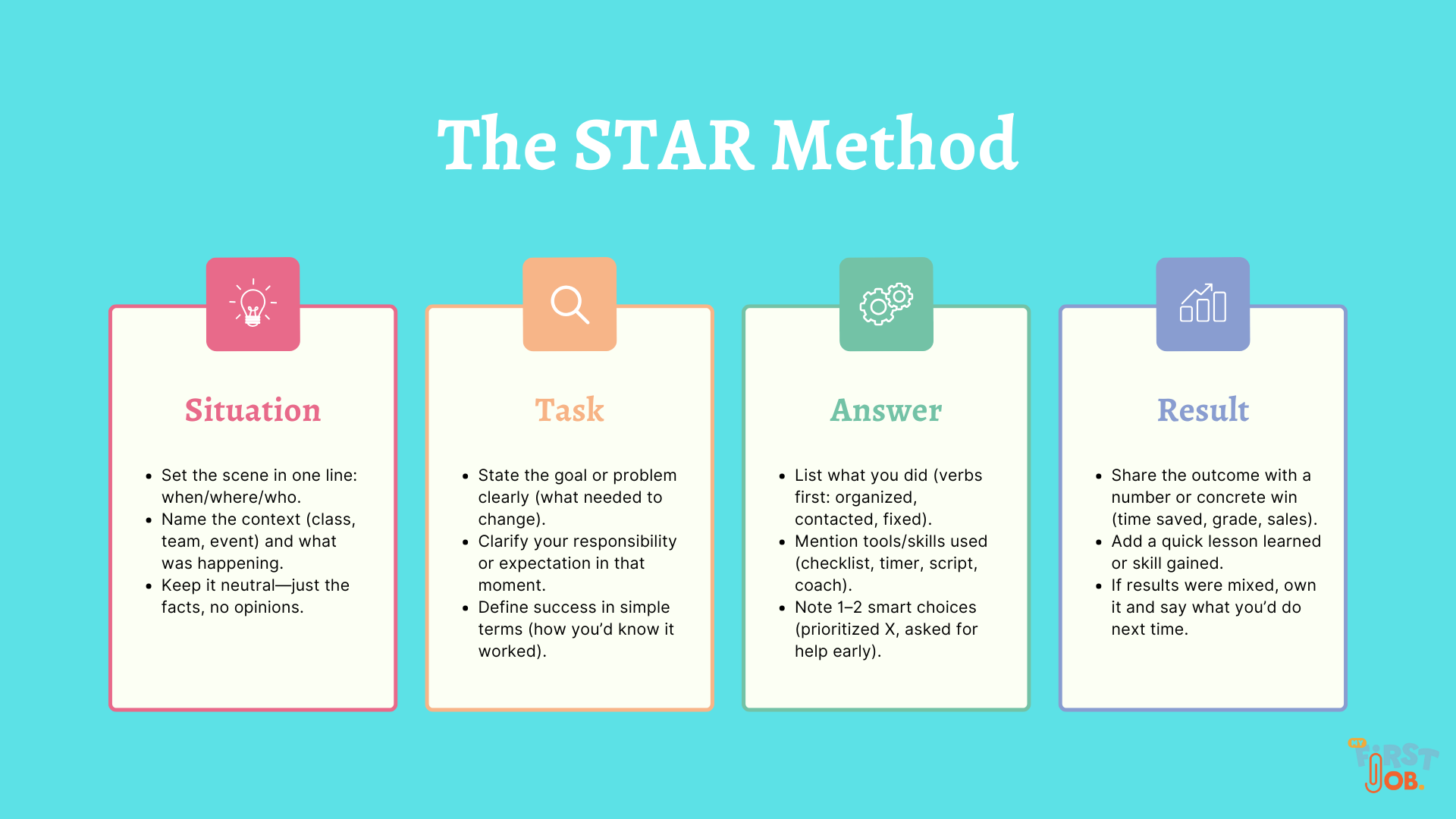
Prove Soft Skills in Interviews (Use STAR)
- Situation — Set the scene in one line.
- Task — What needed to change?
- Action — What you did (verbs first).
- Result — Outcome with a number, plus one lesson.
Example (Teamwork):
"S: Group project; one member ghosted. T: Deadline in two weeks. A: Checked in privately, scaled their role, redistributed tasks, set shared doc deadlines. R: Finished on time, 94% grade; classmate thanked me for keeping them in the loop."
The Skills-First Tailwind (Why This Matters Right Now)
Two things are true at once:
- Youth unemployment moved up to 10.8% in July 2025, so employers can be choosier.
- Employers are actively broadening who they consider by removing some degree requirements and focusing on skills that predict success.
For teens, that's good news. You can compete—and win—by showing soft skills with receipts: attendance, leadership in clubs, sports under pressure, volunteer service, and reliable part-time work.
Your 30-Day Soft Skills Action Plan
Week 1 — Assess & Aim
- Do the skills audit (1–10).
- Pick one weak skill to focus on; set three actions.
- Update one resume bullet to include numbers + verbs.
Week 2 — Reps & Feedback
- Practice the focus skill in two contexts (school + home or team).
- Ask a teacher/coach for specific feedback ("What two behaviors would raise my grade/performance fastest?").
- Record a 60-second STAR story on your phone.
Week 3 — Stretch & Document
- Take one uncomfortable role (lead warm-ups, present a slide, handle announcements).
- Log outcomes: time saved, people helped, error reduced.
Week 4 — Showcase & Iterate
- Add two "proof" bullets to your resume.
- Practice two behavioral interview questions out loud.
- Ask a mentor to do a mock interview and score you.
FAQs Teens Ask (And Straight Answers)
"Can I get hired without experience?"
Yes—if you prove soft skills. That's the interview edge.
"What if I'm shy?"
You don't need to be loud; you need to be clear and reliable. Prepare scripts. Practice twice.
"How do I stand out?"
Bring numbers (hours, dollars raised, people served), a thank-you email, and a specific reason you want that company.
"Does school count?"
Absolutely. Sports, clubs, and group projects are soft-skill gyms. Name the skill, tell the story, show the result.
Remember This
You don't need years of experience to land your first job. You need to demonstrate the ten soft skills that make someone valuable on any team:
Communication · Teamwork · Time Management · Problem-Solving · Adaptability · Work Ethic · Customer Service · Attention to Detail · Positive Attitude · Professionalism
You've been building these for years—now it's time to name them, train them, and show them.
Next step: Use our practice tools at /ai-tools to build STAR stories and resume bullets, then check /pricing for a plan that fits. Put in 30 days of focused reps and walk into your interview with proof.
Citations
- Youth labor market: U.S. Bureau of Labor Statistics—Employment and Unemployment Among Youth, July 2025 (10.8% unemployment; higher than July 2024).
- Skills-first trend / reduced degree barriers: SHRM—skills-first policies and recruiting trends; states removing degree barriers; ongoing talent shortages.
- Soft skills from part-time work & career guidance: OECD—Teenage Part-time Working (2025) and State of Global Teenage Career Preparation (2025).
Tags: soft-skills, career-skills, employability, teen-jobs, professional-development