Common First Job Interview Questions: Answers That Get You Hired
Interviews · 18 min read · Published 2025-10-28
TL;DR
Teen job interviews are predictable. Learn the STAR method, prepare 5 reusable stories (teamwork, problem-solving, leadership, conflict, failure), and follow this guide's question-by-question frameworks. Practice your answers 3–5 times, arrive 10–15 minutes early, and send a thank-you email within 24 hours. Preparation is your edge.
Walking into your first job interview can feel like stepping onto a stage with the spotlight too bright and the script half-memorized. The good news: teen job interviews are highly predictable—employers tend to ask the same core questions and they're not grading you on years of experience. They're looking for coachability, reliability, and real enthusiasm. In July 2025, youth unemployment was 10.8% in the U.S., up from 9.8% a year earlier—so preparation is your edge in a tighter market.
In this guide, you'll learn the STAR method for answering any behavioral question, see 15 common interview questions with ready-to-use frameworks, get industry-specific tips for retail, food service, and recreation roles, and follow a before/during/after game plan that actually works. I'll keep it honest and practical—the way we'd train a new crew member on their first day—no fluff, just tools you can use.
The STAR Method: Your Interview Secret Weapon
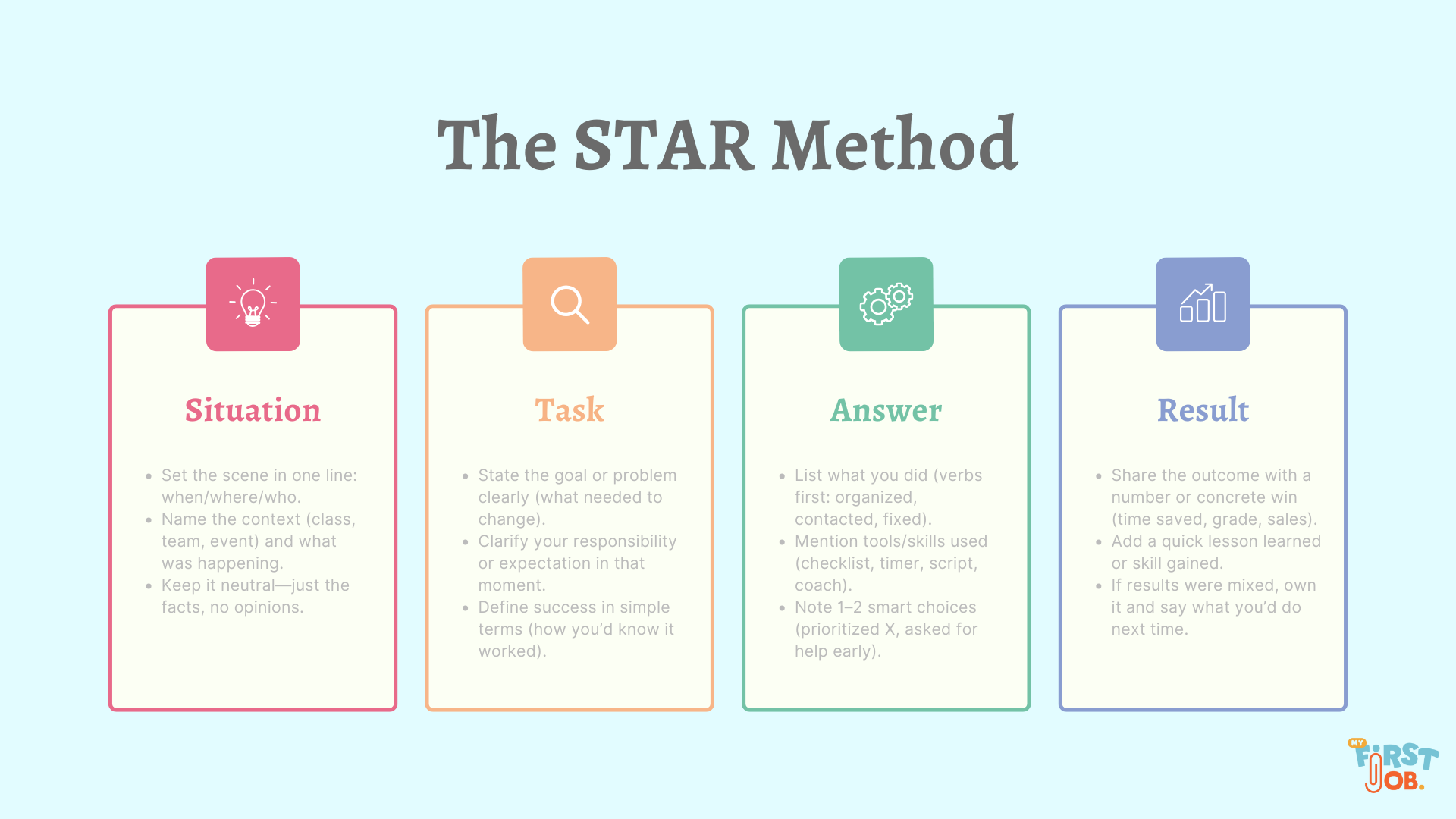
When you don't have a long resume, stories do the heavy lifting. The STAR framework turns everyday experiences into evidence:
- S – Situation: Set the scene briefly (when/where/who).
- T – Task: What needed doing or what challenge you faced.
- A – Action: What you did specifically (not "we").
- R – Result: Outcome or lesson—numbers if possible.
Why STAR works for first-time job seekers
- Avoids rambling; gives your answer a clear arc.
- Proves skills through real examples (school, sports, volunteering).
- Signals self-awareness and accountability—gold to hiring managers.
Example (Teamwork)
Question: "Tell me about a time you worked as part of a team."
STAR answer: "Situation: Last spring our soccer team was 2–4 and morale was low. Task: As a midfielder, I saw communication breaking down between offense and defense. Action: I organized two weekend practices for passing + talking drills and started calling plays more clearly in matches. Result: We went 5–1 over the next six games and made the playoffs; the coach called out our improved communication. I learned leadership can be as simple as helping others succeed."
The 15 Most Common First Job Interview Questions (With Answer Frameworks)
Below are the questions you'll almost certainly hear, what they really mean, and plug-and-play structures you can adapt. Parents: use these to coach practice sessions. Employers: these prompts help you evaluate soft skills quickly and fairly.
Pro move: Prepare 3–5 short STAR stories that cover teamwork, problem-solving, leadership, conflict, and a mistake you learned from. You'll reuse them across multiple questions.
1) "Tell me about yourself."
What they're really asking: Can you communicate clearly and keep it relevant?
Structure (90 seconds max): School/grade → one strength/proof → why this job → availability.
Retail example: "I'm a junior at Lincoln High (3.5 GPA). As debate captain I've built strong communication skills and I'm comfortable with all kinds of people. I shop here a lot and notice how your team helps customers quickly; I want to learn that level of service. I'm free weeknights after 4 p.m. and weekends."
What not to do: Life story, "I just need money," or complaints about school.
2) "Why do you want to work here?"
They're checking: Did you research us or just mass-apply?
Structure: 1 specific thing you admire → 1 value you share → 1 skill you want to learn here.
Coffee shop example: "I've seen your baristas remember names and orders—that's the kind of connection I want to learn. You also invest in training and promote from within. I'm looking for a first job where I can grow, not just clock in."
3) "Why should we hire you?"
They're checking: What makes you different from 20 similar applicants?
Structure: 1 strength + proof → 1 reliability signal → eagerness to learn.
Example: "You should hire me because I learn fast and show up. I had a 98% attendance record last year. I also got lifeguard certified in 3 weeks (typical is 4–6), which shows I pick things up quickly. I want to bring that energy here and keep improving."
4) "What's your greatest strength?"
They're checking: Self-awareness and relevance.
Structure: Choose one that fits the role (communication, adaptability, detail orientation, etc.), give a specific example, and connect it to the job.
Example: "My strength is adaptability. When yearbook lost a photographer, I learned the basics in a month and covered events. In a quick-service restaurant, I can flex to different stations as needed."
5) "What's your greatest weakness?"
They're checking: Can you be honest and are you working on it?
Structure: Pick a real but fixable weakness + the system you use to improve.
Example: "I used to wait too long to ask for help. Now I follow a '15-minute rule'—if I'm stuck for 15 minutes, I ask. It speeds up learning and prevents small errors from becoming big ones."
6) "Describe a time you dealt with a difficult situation."
They're checking: Your problem-solving and composure.
Structure: Use STAR and pick a school/sports/volunteer story where you clarified expectations, communicated, and followed through.
7) "How would you handle an angry customer?"
They're checking: Emotional maturity.
Framework: Stay calm → Listen and repeat back → Apologize → Solve or escalate appropriately.
Phrase bank: "I'm sorry for the frustration." / "Here's what I can do right now." / "Let me loop in a supervisor so we fix this quickly."
8) "What do you do for fun?"
They're checking: Culture fit and transferrable skills.
Structure: Share 2–3 genuine interests and link to work traits (patience, focus, teamwork). Avoid schedule conflicts.
9) "Where do you see yourself in five years?"
They're checking: Basic planning and likely commitment.
Structure: Keep it realistic: learning, responsibility, maybe school, maybe internal growth.
Example (still in HS): "In five years I'll likely be in college. Short term, I'd like to earn trainer or shift-lead responsibilities if I perform well."
10) "How do you handle stress?"
They're checking: Will you freeze during a rush?
Structure: Name a concrete technique (prioritization list, breath reset, ask for help) and a time it worked.
11) "Tell me about a time you showed leadership."
No title required. Think: teaching someone, organizing an event, fixing a recurring problem.
12) "Why did you leave your last job?" (if applicable)
Rules: Stay positive, never trash anyone, stay brief (seasonal job ended, schedule changed, seeking growth).
13) "What's your availability?"
Be specific. If limited, emphasize reliability during those hours and willingness to pick up shifts.
14) "Do you have any questions for us?"
Always ask 2–3—it signals real interest. Try: "What does success look like in 30/60/90 days?" or "How does training work here?"
15) "How would your friends/teachers describe you?"
Pick 2–3 traits and back each with proof ("My coach would say I'm reliable; I haven't missed a practice in two seasons.").
Quick Reference Table: Question → What They Want → Answer Skeleton
| Question | What They're Really Checking | Answer Skeleton |
|---|---|---|
| Tell me about yourself | Clear, relevant communication | School/grade → 1 strength + proof → why this job → availability |
| Why this company? | Research + motivation | Specific thing → shared value → skill you'll learn |
| Why hire you? | Differentiator + reliability | Strength + proof → reliability metric → eagerness to learn |
| Greatest strength | Relevance + example | 1 strength → STAR mini-story → tie to role |
| Greatest weakness | Honesty + growth | Real but fixable → system you use now |
| Difficult situation | Problem-solving under pressure | STAR story → lesson |
| Angry customer | Composure + empathy | Listen → apologize → solution → escalate if needed |
| Questions for us | Engagement | 2–3 thoughtful, job-focused questions |

Industry-Specific Tips (Retail, Food Service, Recreation/Camp)
Retail
They prioritize: Customer service, punctuality, accuracy with cash, teamwork.
Expect extras: Handling returns, spotting loss prevention issues, going "one step further" for customers.
Practice prompt: "A customer wants to return an item without a receipt."
Answer idea: Empathize, explain policy, offer acceptable alternatives (store credit, manager approval), and loop in a supervisor.
Food Service
They prioritize: Speed under pressure, safety/cleanliness, multitasking, communication in tight spaces.
Practice prompt: "There's a 10-ticket rush."
Answer idea: Call back orders, confirm priorities with line lead, keep your station clean and stocked, ask for hands when needed, close tickets one by one.
Recreation/Camp
They prioritize: Energy, safety awareness, communicating with parents, patience and creativity with kids.
Practice prompt: "Child meltdown during pick-up."
Answer idea: Ensure safety, use calm tone, validate feelings, redirect with options, brief parent with facts (no judgment), and note for supervisor.
Before, During, After: The Complete Interview Strategy
One Week Out (Prep that Pays Off)
- Research the company: site, reviews, visit a location.
- Prepare 5 STAR stories: teamwork, problem-solving, leadership, conflict, failure/learning.
- Choose your outfit (one step above the job's normal).
- Print two resumes; gather certifications (CPR, food handler, lifeguard).
- Draft 3 thoughtful questions to ask them.
- E-E-A-T bonus: Employers globally are raising the bar on skills—about 28% of organizations now require new skills even for full-time roles, with many updating existing roles to include them.
Day Of (Showtime)
- Plan to arrive 10–15 minutes early (not 30).
- Phone off (not just silent).
- Smile, eye contact, firm handshake; sit tall.
- Listen to the whole question, pause a beat, then answer.
- Use your STAR stories; ask for clarification if needed.
- Thank them authentically at the end.
Within 24 Hours (Follow-Through)
Send a short, clean thank-you email:
Subject: Thank you — [Your Name], [Position]
Body: Thanks for your time today. I enjoyed learning about [specific detail]. Our conversation made me even more excited to contribute. Please let me know if you need anything else. — [Name], [Phone]
What to Wear (First Impressions Without the Stress)
- Retail: Clean jeans or khakis + collared shirt/sweater.
- Food service: Dark pants + solid polo or button-up.
- Recreation/camp: Neat casual—clean jeans + simple tee/sweatshirt without loud graphics.
- Office: Business casual—slacks + button-up/blouse.
- Universal rules: Clean shoes, neat hair, minimal fragrance, no visible undergarments, keep jewelry simple, cover tattoos if policy suggests.
- Parents: Do a five-minute "fit check" at home and a quick lint-roll in the car. It reduces nerves and prevents last-minute scrambles.

Common Interview Mistakes (And Simple Fixes)
- Showing up late → Do a route test the day before; arrive 10–15 minutes early.
- Trashing past employers/teachers → Use neutral, factual language ("seasonal job ended").
- Over- or under-rehearsing → Practice each answer 3–5 times; aim for smooth, not robotic.
- Only asking about pay/schedule → First show value and what you'll learn; compensation will be covered when they're ready to hire.
- No questions → Bring a small card with 3 questions written down.
- Fidgeting/poor posture → Plant your feet, relax shoulders, breathe low and slow.
- Parent in the interview → Parents can drive you—you go in alone.
- Checking your phone → Off before you enter; you can check messages after.
Build Your Story Bank: 10 Prompts Teens Can Use Today
Use these to craft STAR stories you can recycle across interviews:
- A group project where you improved coordination.
- A time you dealt with a tough deadline and still delivered.
- A customer/guest you helped (volunteering counts).
- A conflict you de-escalated on a team.
- A mistake you owned and fixed.
- A moment you took initiative without being asked.
- A time you learned something fast (new role, tool, or skill).
- A stressful period you organized with a simple system.
- A time you taught or mentored someone.
- A day you balanced school, activities, and family responsibilities.
Template (fill-in-the-blanks):
- S: During ___ at ___ with ___.
- T: We needed to ___ because ___.
- A: I ___ (your specific actions + why).
- R: We ___ (result with numbers if possible), and I learned ___.
Parent & Employer Corner (Two Quick Wins)
For Parents:
- Coach, don't script. Ask one question at a time and let your teen finish.
- Run a mock interview. 15 minutes, phone recorded for playback. Focus on clarity and confidence.
For Employers:
- Ask for one STAR story from school/sports/volunteering to level the playing field for first-timers.
- Train for the behaviors you want. Teens rarely lack effort—they lack a roadmap. A 30-minute onboarding flow (greeting → register basics → closing duties) pays off within a week.
Global Notes (Laws and Culture)
Hiring ages, hour limits, and break rules vary by country and region. Always check your local regulations (e.g., U.S. FLSA youth rules vs. provincial/state standards). Teens: be honest about age and availability; Employers: post clear schedules and break policies up front—trust is built fast when expectations are transparent.
Your Interview Checklist (Copy/Paste to Notes)
- One week before: company research, 5 STAR stories, outfit, print resumes, 3 questions.
- Day before: confirm time/location, plan route/parking, charge phone (then off), sleep 7–9 hours.
- Day of: eat something, arrive 10–15 minutes early, breathe, answer with STAR, thank them.
- Within 24 hours: send thank-you email, note follow-ups, reflect on what to improve.
The Truth About First Job Interviews
- No one expects perfection. Managers can teach tasks; they can't teach reliability and effort.
- Enthusiasm beats experience. Candidates who show they've prepared stand out immediately.
- Research is remembered. Mentioning a product, value, or initiative shows you care.
- Thank-you notes are rare—and powerful. Send one within 24 hours.
In short: prepare, practice, be genuine. Your first interview is rehearsal for the rest of your career—communication, poise, resilience. Nail those and the rest follows.
Ready to Practice With Tools That Coach You Step-by-Step?
Try our Follow-Up Coach and Interview Prep tools at /ai-tools to rehearse answers with instant feedback. Bring your stories, get structured prompts, and export a one-page "interview cheat sheet."
When you're ready to level up, compare plans at /pricing and start a free 7-day trial.
You've got this. Show up prepared, tell the truth, and let your work ethic do the talking.
Tags: Interview, First Job, STAR Method, Teen, Students, Career Tips