Your First Day at Work: What to Expect and How to Succeed
Getting Started · 13 min read · Published 2025-11-05
TL;DR
First days follow a rhythm: arrive early (10–15 min), bring required docs (I-9, W-4, direct deposit info), dress industry-appropriate, complete paperwork (hour 1), shadow + learn basics (hours 2–6), take notes, use names, ask questions, and observe culture. Five trust builders: be early, use names, ask smart questions, take notes, watch culture. Five impression sinkers: phone use, complaining, oversharing, acting like you know everything, ignoring safety. Youth unemployment is 12.6% globally (2025)—show reliability and coachability to stand out.
Congratulations—you landed the job. Now comes the part that can feel even more nerve-wracking than the interview: day one. The good news is that first days follow a predictable rhythm across retail, food service, recreation, and office roles. If you show up prepared, on time, and curious, you'll build momentum that carries you through your first week and beyond. Globally, youth unemployment remains far higher than adult unemployment (around 12.6% in 2025), so making a smooth transition into work is worth celebrating—and preparing for carefully.

Before Your First Day: Critical Preparation
First days are smoother when you treat them like a short road trip: you've mapped the route, packed essentials, and planned a buffer for traffic. You're aiming to arrive 15 minutes early, calm and ready.
Required Documents (Bring These!)
In the U.S., employers must verify your identity and work authorization using Form I-9. You'll either show one List A document (proves identity and work authorization) or a List B (identity) plus List C (work authorization). Examples include:
- List A: U.S. Passport, Permanent Resident Card, Employment Authorization Document.
- List B: Driver's license or state ID, school ID with photo.
- List C: Social Security card, original or certified birth certificate.
You'll also complete tax withholding using Form W-4 (Employee's Withholding Certificate)—that's how your employer knows how much federal income tax to withhold from your pay. If your life changes (more jobs, dependents), you can submit an updated W-4 at any time.
Other helpful items to bring:
- Direct deposit info: bank name, account and routing numbers; some employers accept a voided check or a direct-deposit authorization form.
- Emergency contact details.
- Relevant certifications: Food handler card, CPR/First Aid, Lifeguard, etc.
Pro tip: Snap photos of your documents before you go (and still bring originals for I-9). If something's missing, you'll know exactly what to grab later.
What to Wear (Industry-By-Industry)
- Retail: Clean dark jeans/khakis; solid polo or button-up; closed-toe shoes; minimal jewelry; hair neat or tied back.
- Food Service: Dark pants; solid tee/polo; hair secured; non-slip shoes if you have them; remove excess jewelry or nail polish if policy requires.
- Recreation/Camp: Athletic or outdoor-friendly clothing; sneakers; sunscreen/water bottle.
- Office/Reception: Business casual—slacks/skirt + blouse/button-up; closed-toe shoes; subtle accessories.
Universal first-day rules: Clean and wrinkle-free, light/no fragrance, good hygiene, no visible undergarments, and don't overdress (a suit at a burger stand reads "out of touch").
Night-Before Checklist
- Set two alarms (phone + backup).
- Map the route and parking; plan to arrive 15 minutes early.
- Charge phone fully; pack a small notebook + pen.
- Put all documents in a single folder.
- Pack lunch/snacks and a water bottle.
- Lay out your outfit.
- Review any onboarding email/portal info.
- Sleep 7–9 hours (non-negotiable for a clear head).
Hour-by-Hour: What Actually Happens on Day One
First 30 Minutes: Arrival and Check-In
What happens: You announce yourself to a manager or receptionist, get a quick tour of employee areas (breakroom, lockers, restrooms), and settle at a spot for paperwork.
What to do: Arrive 10–15 minutes early; greet people by name; store your phone; ask where bags/food go; smile and make eye contact.
Common mistake: Cutting it close because you underestimated parking or building navigation. Build buffer time.
Hour 1: Paperwork
Expect these forms:
- W-4 (Federal Withholding): Determines federal tax withholding; you can adjust later if needed.
- State withholding form: Similar to W-4, but for state taxes (if applicable).
- I-9 (Employment Eligibility): Employer verifies your identity/work authorization with your original documents.
- Direct deposit authorization: Requires bank/routing numbers; some employers accept a voided check or payroll card alternatives.
- Emergency contact form.
- Handbook acknowledgment: Confirms you received policies (dress code, breaks, call-out rules).
- Confidentiality/NDA (if applicable).
Paperwork tips: Ask questions, read before signing, note your employee ID/login, and (if permitted) take a photo of completed forms for your records.
Hours 2–4: Orientation and Safety
What happens: Company overview (history, values), safety training (exits, alarms, first-aid), time-clock setup, systems logins, facility tour, and intros to teammates.
What to do: Take notes, ask questions, write down names, and pay special attention to safety and where things live (cleaning supplies, first aid, manager's office, etc.).
Topics they'll likely cover:
- Pay cycle (weekly/biweekly) and how to view pay stubs.
- Break rules (paid vs. unpaid; timing and length).
- Call-in/shift-swap procedures.
- Dress code specifics; hair and jewelry policies.
- Employee discounts or perks (if offered).
Name-memory trick: Use the person's name right after they share it—"Great to meet you, Sarah"—then jot it down later.
Hours 4–6: Shadowing and Hands-On Basics
What happens: You'll shadow a trained coworker, observing how they greet customers, run the register, prep food, file paperwork, set up rooms, or manage inventory. You'll get low-risk tasks first and gradually try steps yourself.
What to do: Watch the why, not just the what. Ask, "Why do we do it this way?" Take notes on sequences, wording, and the order of operations. Offer to try a step when invited—"Can I give that a shot?"
Typical first-day tasks by industry:
- Retail: Greeting customers, folding/stocking, learning register basics, tidying fitting rooms.
- Food Service: Portioning, labeling, dish/pit basics, sanitizing, station setup/teardown, observing expo/cash.
- Office: Phone system basics, filing, scanning, data entry, mail runs, calendar requests.
- Recreation: Activity setup/cleanup, equipment checks, participant check-in, safety walk-throughs.
What NOT to do: Touch machines you haven't been cleared to use, "humble-brag" that you already know everything, complain about boredom/busy-ness, or camp on your phone.
Final 30 Minutes: Wrap-Up and Next Steps
What happens: Quick debrief with your trainer/manager: what went well, what's next, and when you're scheduled again. You may sign final acknowledgments.
What to do: Confirm your next shift, arrival time, dress/gear, where to meet, and who to text if you have questions. Thank your trainer and manager. Leave a few minutes after your scheduled end (don't sprint out at the exact minute on day one).
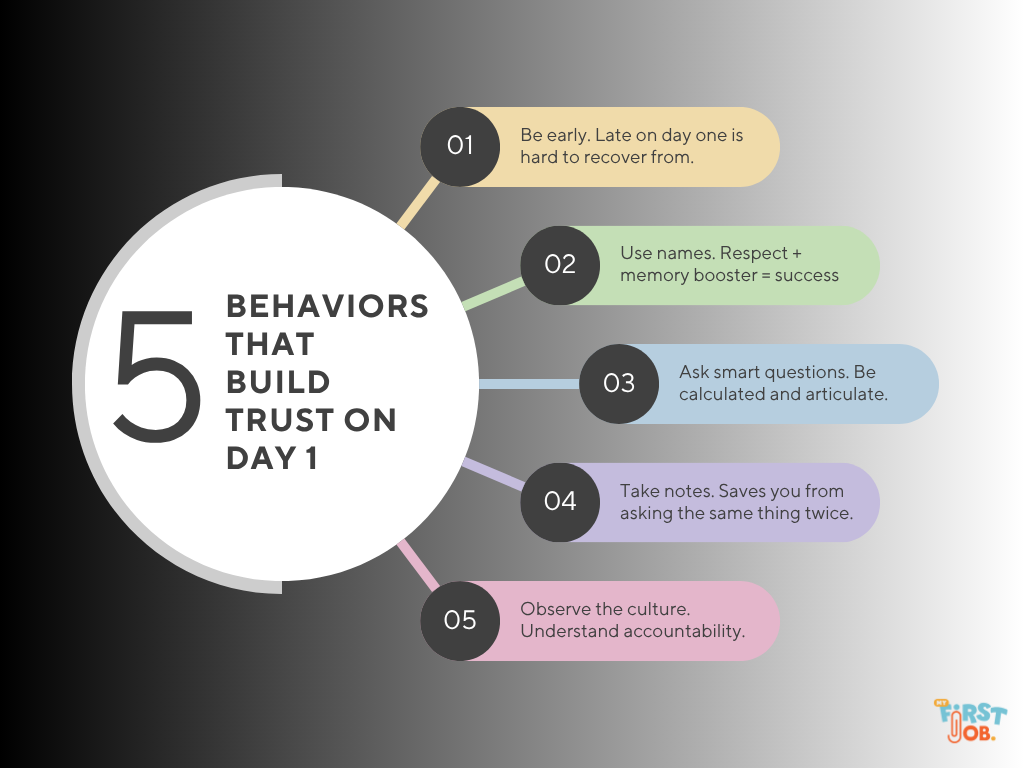
Make a First Impression That Sticks
Five Behaviors That Build Trust on Day One
- Be early. Late on day one is hard to recover from.
- Use names. Respect + memory booster.
- Ask smart questions. Try: "What's the most important thing to learn first?" "What gets people promoted here?"
- Take notes. Saves you from asking the same thing twice.
- Observe culture. Watch communication style, pace, teamwork, and how mistakes get handled.
Five Behaviors That Sink First Impressions
- Being on your phone (even on breaks, keep it minimal).
- Complaining (about boredom, policies, or customers).
- Oversharing personal drama.
- Acting like you "already know."
- Ignoring safety rules or taking shortcuts.
Common First-Day Situations (and Scripts That Help)
You don't understand something.
"I want to get this right—could you walk me through the part where we ___ one more time?"
Someone seems rude or unwelcoming.
Stay kind and professional; invest energy in the teammates who are helpful. First days are busy for everyone.
You make a mistake.
"That one's on me—what's the best way to fix it and prevent it next time?"
It's slow and you have nothing to do.
"What should I focus on during slow periods—cleaning, restocking, or learning the product binder?"
The job isn't what you expected.
Give it two weeks. Competence increases happiness. Re-evaluate after you've seen a full schedule cycle.
Your trainer is rushing.
Ask specific questions ("Where did you click to get that report?" vs. "Can you explain everything again?"). If it persists, request a quick check-in with the manager for extra training time.
What Employers Wish Every New Hire Knew
- No one expects perfection on day one. We're watching attitude, effort, and how you respond to feedback.
- Questions are cheaper than fixes. Asking now saves time (and money) later.
- Punctuality and enthusiasm are loud signals. Show up early, lean in, and say thank you.
- First impressions matter, but consistency wins. We remember your week-two reliability even more than your day-one polish.
The First Week: Turn a Good Start into a Great Pattern
Days 2–3: Lock In the Basics
- Review your notes each night for five minutes.
- Reduce repeat questions; still ask when you're unsure.
- Start anticipating the next step: "I finished X—should I set up Y?"
Days 4–5: Show Reliability
- On time (or early) every shift.
- Close loops without reminders.
- Keep your station clean and stocked.
- Offer to help adjacent stations when you're free.
End-of-Week Goals
- You know coworkers' names and roles.
- You can complete the main tasks without hand-holding.
- You know how to check your schedule and request changes.
- You know break policies and where key items are (first aid, SDS book, etc.).
- You can explain the "order of operations" for your core task.
After Your First Day: Follow-Up Actions
That Evening
- Review your notes while details are fresh; add names to your phone (with a hint about who's who).
- Pack documents/lunch for day two; set alarms; confirm route.
- Reflect: one thing you did well, one thing to improve tomorrow.
Optional but Impressive
Send a short thank-you message to your manager:
"Hi [Name], thanks for the warm welcome today. I'm excited to be part of the team and looking forward to learning more tomorrow. See you at [time]. —[Your Name]"
Industry-Specific Quick Wins
Retail
- Learn how to greet + redirect: "Welcome in! What can I help you find today?"
- Master recovery: tidy as you go, restock during lulls, know fitting-room flow.
- Understand returns basics and when to call a supervisor.
Food Service
- Sanitize correctly; learn the flow (prep → hold → serve → clean).
- Call back orders clearly; ask for hands during a rush.
- Non-slip shoes and hair control aren't "nice to have"—they're safety.
Recreation/Camp
- Safety beats schedule; keep eyes up.
- Learn family communication norms (pickup rules, incident reports).
- Have a backup activity in your pocket for rainy or low-energy moments.
Office
- Phone etiquette (smile, verify names, concise messages).
- Calendar requests done right; name files clearly.
- Protect quiet focus time and ask how the team prefers to communicate (chat vs. email).
Your Day-One Checklist
Documents to Bring
- Social Security card (original) or other List C document.
- Driver's license/state ID or school ID (List B).
- Passport/Green Card/EAD (List A, optional alternative).
- Bank routing + account numbers (direct deposit) or voided check.
- Emergency contact info; relevant certifications.
What to Wear
- Industry-appropriate outfit; closed-toe shoes; hair neat/tied back.
- Minimal jewelry/fragrance; uniform items if provided.
What to Bring
- Small notebook + pen; water bottle; lunch/snacks.
- A few prepared questions.
- Positive attitude and curiosity.
Mindset
- Expect information overload (normal).
- Ask questions instead of guessing.
- Keep the phone away.
- Remember: everyone was new once.
Why This Matters (Beyond Day One)
A growing share of employers are embracing skills-first hiring and reducing degree requirements in some roles—especially in hospitality, food/leisure, government, and education. That means your attitude, consistency, and learning speed on the job matter more than ever.
Your first day is your runway: show reliability, coachability, and care for customers. Keep that pattern going for two weeks, and you won't just fit in—you'll be on a fast track for better shifts, more responsibility, and stronger references.
Ready to Practice the Soft Skills That Make Day One Easy?
Use our micro-tools at /ai-tools to rehearse greetings, phone etiquette, and first-week checklists. When you're ready to go deeper, compare plans at /pricing and start your free 7-day trial. Show up early, take notes, ask questions, and let your work ethic speak for you. You've got this.
Citations
- Youth employment context: International Labour Organization, World Employment and Social Outlook: Trends 2025 (youth unemployment around 12.6%).
- I-9 acceptable documents (identity & work authorization): USCIS I-9 Central; Form I-9 official resources.
- W-4 purpose and updates: IRS — About Form W-4; 2025 Form W-4.
- Direct deposit setup (employee info required): ADP and Paychex employer guides; Bank of America direct deposit overview.
- Skills-first/reduced degree requirements trend: SHRM 2025 Talent Trends; SHRM reporting on declining degree/experience requirements.
Tags: first-day, getting-started, teen-jobs, workplace-tips